1. What Is Amazon Nova?
Building generative AI applications requires choosing models that can understand user requests, process different types of data, and generate useful responses. However, selecting the right model can be challenging because applications have different requirements for accuracy, response time, input formats, and cost.
Amazon Nova is a portfolio of AI models and related offerings from Amazon Web Services (AWS) designed to support a range of generative AI applications. Developers can use supported Nova models through Amazon Bedrock to build applications that generate text, analyze content, process multimodal inputs, and support conversational experiences.
Unlike traditional machine learning workflows that may require organizations to train and host models themselves, using a managed model through Amazon Bedrock allows developers to focus on application logic and integration without managing the underlying model infrastructure.
Why Does Amazon Nova Matter?
Amazon Nova provides options for different AI workloads, allowing developers to select models according to their application's requirements. For example, an application that summarizes business documents may need different capabilities from a voice assistant or a system that searches images and other content by meaning.
Depending on the selected model, Amazon Nova can support use cases such as:
- Text generation and reasoning: Generate responses, summarize documents, and assist with tasks that require analysis.
- Multimodal understanding: Process supported combinations of text, images, video, and other content types.
- Speech based applications: Enable natural voice interactions through compatible models.
- Semantic search: Generate embeddings that help applications find relevant content based on meaning.
- AI powered automation: Support broader workflows through related offerings such as Nova Act.
Amazon Nova is part of the broader AWS AI ecosystem. Amazon Bedrock provides managed access to supported foundation models, while application developers remain responsible for integrating those models into their software and implementing the required security and business logic.
Understanding the different Nova offerings is therefore the first step toward selecting an appropriate model for a particular application.
2. Amazon Nova vs. Amazon Bedrock: Understanding the Difference
Amazon Nova and Amazon Bedrock are closely related, but they serve different purposes within the AWS AI ecosystem. Understanding this distinction helps developers choose the right model and integrate it into their applications.
Amazon Nova is a portfolio of AI models and related offerings developed by AWS. Amazon Bedrock is a managed service that provides access to supported foundation models and tools for building generative AI applications.
In simple terms, Nova provides the AI model, while Bedrock provides the managed service through which applications can access supported Nova models.
How Do Amazon Nova and Amazon Bedrock Differ?
| Feature | Amazon Nova | Amazon Bedrock |
| Primary purpose | Provides AI models and related offerings | Provides managed access to foundation models and generative AI capabilities |
| Main role | Processes supported inputs and generates outputs | Enables applications to invoke supported models through APIs |
| Model selection | Offers different models for specific workloads | Allows developers to select from supported models and providers |
| Application integration | Supplies model capabilities | Provides APIs and supporting features for application development |
| Infrastructure management | Depends on the specific Nova offering | Manages the underlying infrastructure for supported model inference |
Amazon Bedrock supports models from multiple providers, not just Amazon Nova. This allows developers to evaluate different models and choose an option that fits their application's requirements.
How Do They Work Together?
Consider an application that summarizes uploaded business documents.
- User submits a document: The application receives a document and a request to summarize its contents.
- Application prepares the request: The backend validates the input and prepares the appropriate model request.
- Amazon Bedrock invokes Nova: The application calls a compatible Nova model through the relevant Bedrock API.
- Nova generates the output: The selected model processes the supported input and produces a summary.
- Application returns the result: The backend handles the response and displays the summary to the user.
This approach allows developers to integrate AI capabilities without building and managing the foundation model infrastructure themselves.
When Should You Use Amazon Nova and Amazon Bedrock?
The two are not mutually exclusive alternatives. When using a Nova model through Bedrock, you use both as parts of the same solution.
Choose a suitable Nova model when its capabilities match your workload. Use Amazon Bedrock as the managed service for accessing supported models and integrating inference into your application.
For example, a developer building a document summarization application could use a compatible Nova model through Bedrock. A team building a semantic search system might instead use a supported embedding model and a vector database to retrieve relevant documents.
The key is to select the model based on the task, then design the surrounding application to handle data, security, retrieval, and business logic.
3. Understanding the Amazon Nova Model Families
Amazon Nova offers different models and AI capabilities designed for different application requirements. Some models focus on text generation and reasoning, while others support conversational speech or help applications search across different types of content.
Choosing the right model depends on the task, the input data, the expected output, and the application's performance and cost requirements. Instead of treating every Nova offering as interchangeable, developers should understand the purpose of each model before integrating it into an application.
Amazon Nova 2 Lite
Amazon Nova 2 Lite is a fast, cost effective reasoning model designed for everyday AI workloads and production applications that require a balance between performance and cost.
It supports text generation and can process supported multimodal inputs, including images, documents, and videos. Its reasoning capabilities also help with tasks that require more analysis than straightforward text generation.
Common use cases include:
- Document processing: Summarizing reports, extracting information, and answering questions about business documents.
- Customer support: Generating responses to user questions and helping support teams process requests.
- Business automation: Processing information and supporting workflows that combine AI with application logic.
- Video analysis: Summarizing video content and identifying relevant information from visual frames.
For example, an enterprise could build an application that accepts a lengthy business report and generates a summary highlighting key findings. The application could invoke Nova 2 Lite through Amazon Bedrock and display the generated summary to the user.
Nova 2 Lite is a suitable starting point for applications that need broad capabilities without automatically selecting a more specialized model for every task.
Amazon Nova 2 Sonic
Amazon Nova 2 Sonic is designed for real time conversational AI involving speech and text. It enables developers to build applications that understand spoken input and generate natural speech responses.
Unlike a text focused model interaction, voice applications must handle conversational flow, response timing, and the transition between a user speaking and the system responding.
Common use cases include:
- Voice assistants: Building applications that users can interact with through natural conversation.
- Customer service automation: Supporting voice based customer interactions and answering common questions.
- Conversational applications: Enabling speech driven experiences where users can ask questions and receive spoken responses.
For example, a customer service application could use Nova 2 Sonic to support a voice conversation in which a customer asks about an order and receives a spoken response.
Developers should evaluate language support, latency, conversation handling, and integration requirements when selecting a speech model for a production application.
Amazon Nova Multimodal Embeddings
Amazon Nova Multimodal Embeddings serves a different purpose from models that generate conversational responses. It converts supported content into numerical representations called embeddings, which applications can use to identify semantically similar content.
These embeddings allow applications to search by meaning rather than relying exclusively on exact keyword matches. The model supports text, images, documents, video, and audio for supported embedding workflows.
Common use cases include:
- Semantic search: Finding documents that are conceptually related to a user's query.
- Cross modal search: Finding relevant images or other supported media using a query from a different content type.
- Recommendation systems: Identifying similar items based on their content.
- Retrieval augmented generation (RAG): Retrieving relevant information from a knowledge base before sending context to a generative model.
For example, a company could create a searchable knowledge base containing product documents and images. It could generate embeddings for the content, store the vectors in a compatible vector database, and retrieve relevant results when a user submits a query.
The embedding model helps identify relevant information, but a complete search or RAG application also requires retrieval logic and, when generated answers are needed, an appropriate response generation model.
Other Offerings in the Amazon Nova Portfolio
In addition to the models described above, the wider Amazon Nova portfolio includes offerings for browser automation and model customization.
Amazon Nova Act supports building AI agents that perform browser based user interface tasks. It is relevant when an application needs to interact with websites or web applications as part of a workflow.
Amazon Nova Forge supports organizations that want to build customized models using Nova capabilities and their own data. It is intended for more advanced model development rather than simply invoking a ready to use model through an API.
These offerings address different needs. Nova Act focuses on browser based automation, while Nova Forge supports customized model development. Neither should be treated as a direct substitute for a general purpose inference model.
How Do You Choose the Right Amazon Nova Model?
The best choice depends on the problem the application needs to solve.
| Application requirement | Suitable starting point |
| Text generation, document understanding, and general reasoning | Amazon Nova 2 Lite |
| Real time speech conversations | Amazon Nova 2 Sonic |
| Semantic search and multimodal retrieval | Amazon Nova Multimodal Embeddings |
| Browser based workflow automation | Amazon Nova Act |
| Customized model development | Amazon Nova Forge |
4. Key Capabilities of Amazon Nova
Amazon Nova supports several AI capabilities, including multimodal understanding, reasoning, speech interaction, semantic search, and workflow integration. The available capabilities depend on the selected model or offering.
Multimodal Understanding
Compatible Nova models can process supported content such as text, images, documents, and video. Applications can use these capabilities to analyze images, summarize documents, and answer questions about visual information.
Reasoning and Text Generation
Nova models can help applications summarize reports, classify requests, extract information, and analyze instructions. However, developers should validate generated outputs when accuracy is important for business decisions.
Real Time Speech Interaction
Amazon Nova 2 Sonic supports real time speech and text interactions. Developers can use it to build voice assistants and customer support applications that respond to spoken questions. Access to business data and backend systems must be implemented separately.
Embeddings and Semantic Search
Amazon Nova Multimodal Embeddings converts supported content into numerical representations called embeddings. Applications can use these representations to retrieve related documents and media based on meaning rather than exact keyword matches. Embeddings can also support retrieval augmented generation (RAG) applications.
Integration with AI Applications and Workflows
Nova can be integrated with application APIs, databases, and retrieval systems to support end to end workflows. Nova Act supports browser based automation, while Nova Forge supports customized model development. Developers must also implement authentication, data access, monitoring, and error handling.
Choosing Capabilities Based on Application Requirements
Different applications require different AI capabilities. Developers should select an offering based on the task they need to solve.
| Requirement | Capability to evaluate |
| Summarizing reports or analyzing supported documents | Multimodal understanding and text generation |
| Analyzing complex instructions or information | Reasoning |
| Building a voice enabled assistant | Real time speech interaction |
| Searching documents or visual content by meaning | Embeddings and semantic retrieval |
| Automating browser based tasks | Browser workflow automation |
5. Real World Use Cases for Amazon Nova
Amazon Nova capabilities can be applied to business scenarios where applications need to process information, interact with users, or retrieve relevant content.
Document Processing and Analysis
Organizations can use compatible Nova models to summarize reports, extract key information, and answer questions about business documents. For example, an application could process lengthy operational reports and present important findings to a team, reducing the need to review every document manually.
Voice Based Customer Support
Nova 2 Sonic can support voice enabled customer service applications. A customer might ask about an order through a conversational interface, while the application retrieves order details from its backend and uses the model to formulate a response. Access controls and business rules ensure that the application handles customer information appropriately.
Semantic Search Across Enterprise Data
Nova Multimodal Embeddings can help organizations build search systems that retrieve relevant information based on meaning. For example, employees could search technical documentation using everyday language, even when their queries use different wording from the original documents. When combined with a generative model, retrieved content can also support context aware answers.
These use cases illustrate how Nova capabilities can be integrated into applications to address specific business requirements. The final solution depends on model selection, data quality, application architecture, and validation.
6. How Amazon Nova Works on AWS
Amazon Nova can be integrated into an application through Amazon Bedrock. The application manages user requests and business logic, while the selected model processes supported inputs and generates an output.
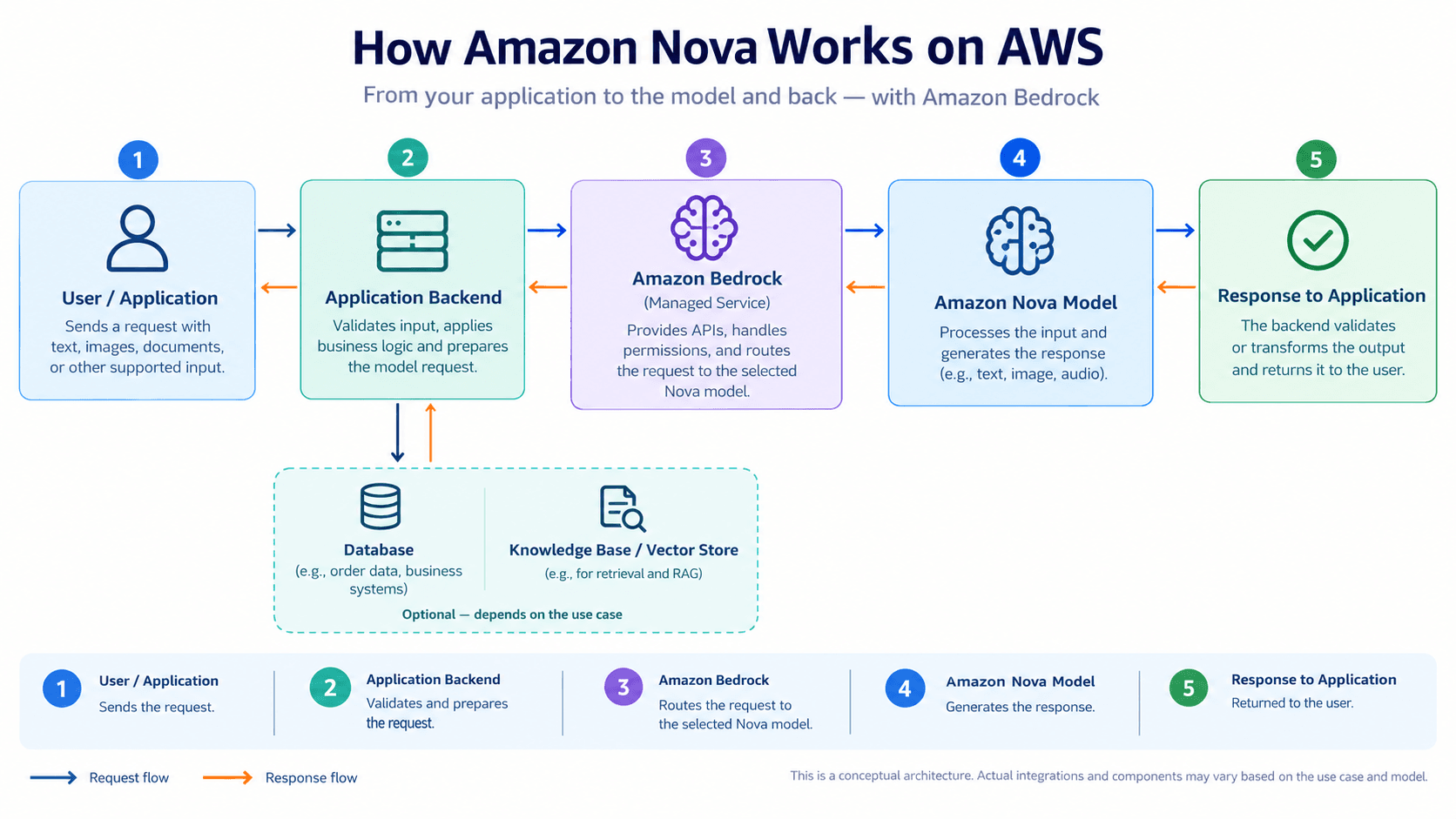
Fig . Amazon Nova working flow
Understanding the Request to Response Flow
A typical integration follows these steps:
- User submits a request: The user enters a question, uploads a document, or provides another supported input.
- Application processes the input: The backend validates the request and prepares the required data.
- Amazon Bedrock invokes Nova: The backend sends the request to the selected Nova model through the appropriate API.
- Nova processes the request: The model analyzes the input and generates a response or other supported output.
- Application handles the response: The backend validates or transforms the result and returns it to the user.
For applications that require external information, the backend can retrieve relevant data from databases or knowledge bases before invoking the model. For example, a customer support system may retrieve order details before generating a response.
What Developers Need to Manage
Although Bedrock provides managed model access, developers remain responsible for the surrounding application. This includes authentication, permissions, data preparation, prompt design, error handling, monitoring, and output validation.
The application must also select a model that supports its required input formats and evaluate latency, quality, and cost before production deployment.
This architecture separates model inference from application logic, allowing developers to integrate Nova into existing systems without managing the underlying model infrastructure themselves.